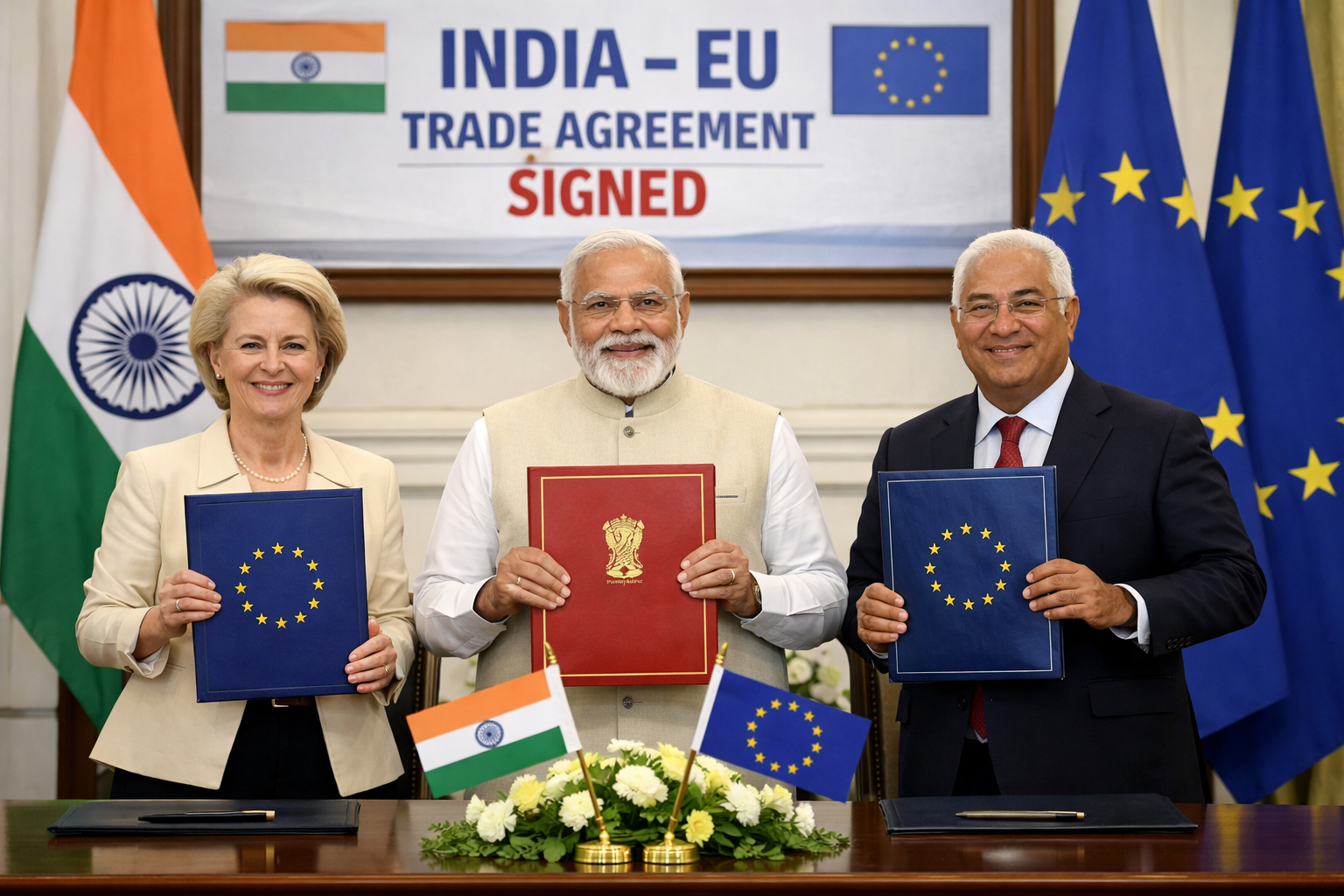
Prime Minister Narendra Modi is to meet European Commission President Ursula von Leyen and European Council President Antonio Costa during the 16th India-Europe Union summit. The private meetings and discussions with their teams were conducted. During these meetings india and the European Union officially announced a Free Trade Agreement, which aims to strengthen the economic cooperation between both sides
After nearly 20 years of negotiations, Europe and India are nearing a trade deal that could reshape tariffs, supply chains, and global trade alliances.@haslindatv explains: https://t.co/1P4FUbuyjZ pic.twitter.com/HH0ViVOk8Z
— Bloomberg (@business) January 22, 2026
The India-EU Free Trade Agreement aims to strengthen economic cooperation by reducing tariffs, improving market access, and encouraging investments across key sectors. The European Union remains one of India’s largest trading partners, with bilateral trade worth billions of dollars annually.
Negotiations Completed After Several Rounds of Talks
The trade agreement comes after years of negotiations between India and the EU. Talks were often delayed due to disagreements over customs duties, environmental standards, data protection rules, and access to markets. Indian negotiators focused on gaining better access for services and manufacturing exports, while the European side emphasised regulatory standards and sustainable trade practices. Officials from both sides held multiple rounds of discussions before reaching a final understanding ahead of the Republic Day celebrations.
Key Areas Covered Under the Trade Deal
The Free Trade Agreement is expected to cover a wide range of sectors including:
- Manufacturing and industrial goods
- Textiles and garments
- Pharmaceuticals and healthcare products
- Agriculture and food processing
- Information technology and digital services
- Renewable energy and green technologies
The deal is expected to remove or reduce import taxes on many products, making goods cheaper and more competitive in both markets.
High-Level Meetings Between Leaders
Prime Minister Modi’s meetings with Ursula von der Leyen and Antonio Costa are expected to focus on trade implementation, future cooperation, and strategic partnerships.
Apart from trade, discussions will also include:
- Climate action and sustainability
- Technological cooperation
- Defense and security
- Global supply chain stability
- Digital economy initiatives
The summit reflects the growing importance of India as a strategic partner for the European Union.
Ursula von der Leyen’s Republic Day Presence
European Commission President Ursula von der Leyen was among the chief guests at India’s Republic Day parade held in New Delhi on January 26. She shared a video clip from the event on social media platform X, writing: “A successful India makes the world more stable, prosperous and secure. And we all benefit.” Her participation in the celebrations highlighted the strengthening diplomatic and economic relationship between India and the EU.
Trade Deal to Take Effect Next Year
Although negotiations have concluded and the agreement will be announced today, the deal will not come into force immediately. Commerce Secretary Rajesh Agrawal stated that the legal review process of the agreement text, known as legal scrubbing, will take around five to six months. Following the legal review, formal signing will be carried out by both sides. After necessary approvals from government bodies in India and EU member states, the agreement is expected to take effect sometime next year.
Expected Impact on Indian Economy
The trade agreement is expected to boost India’s exports to Europe significantly.
Indian industries likely to benefit include:
- Textile and apparel manufacturers
- Pharmaceutical companies
- Engineering and automobile parts producers
- Agricultural exporters
- IT and professional service providers
Lower tariffs and easier regulations are expected to help Indian companies compete more effectively in European markets.The deal is also expected to attract increased foreign investment from European firms into India’s manufacturing and technology sectors.
Benefits for European Businesses
European companies are expected to gain better access to India’s expanding market. Sectors such as automobiles, renewable energy, luxury goods, machinery, and financial services are expected to see growth. The agreement will allow European firms to set up operations more easily and expand trade links with Indian partners.
Reaction From the United States
The conclusion of the India-EU trade deal has drawn attention from the United States, where trade discussions with India are still ongoing. US Treasury Secretary Scott Bessent reportedly expressed strong reactions during a recent news interview. He criticised European countries for purchasing refined Russian oil products from India, stating that they were “financing a war against themselves.” The comments came amid broader global tensions over energy trade and international conflicts. India has previously stated that its energy purchases are driven by economic needs and international trade rules.
Strategic Importance of the Agreement
Analysts say the India-EU Free Trade Agreement strengthens both sides’ positions in the global economy. The deal supports diversification of trade partnerships and reduces reliance on limited markets. It also helps secure supply chains for critical goods and promotes long-term economic stability.
Support Measures and Policy Adjustments
Government officials have indicated that support programs may be introduced to help businesses adapt to new trade rules. Small and medium enterprises in India may receive guidance on export standards and compliance with European regulations. Similarly, European businesses will be assisted in understanding Indian market requirements.
Growing Trade Ties Over the Years
For the Last ten years, the trade between India and the European Union has grown. The European Union is also one of the biggest investors in India. If it is implemented, government officials believe that trade between the two sides will increase more quickly. Many business groups in India and Europe has accepted and welcomed the deal and recognises, it will bring strong economic growth and new opportunities.