
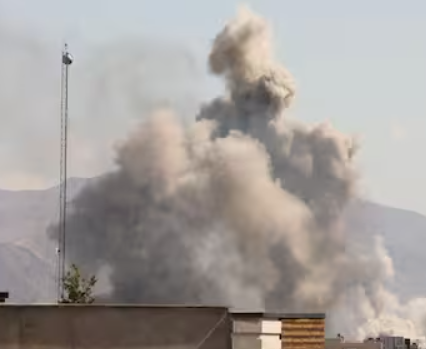
In early March 2026, a major military conflict between Israel, the United States and Iran took a dramatic turn when powerful airstrikes hit parts of Iran’s capital city, Tehran. Among the locations struck was a large medical facility known as Gandhi Hospital, situated on a busy street in the northern part of the city. Videos and photos from the scene showed that the front of the hospital building was heavily damaged, with concrete and glass blown apart, debris scattered across the floors, and wheelchairs and medical equipment lying among the wreckage. People at the site were seen carefully navigating through the ruins, trying to clear broken pieces of the building and rescue those inside. Many patients were being taken out of the hospital, some on stretchers, while others were supported by relatives and medical staff as they walked away from the damaged structure. This hospital is important because it served many people, including those who were already sick or injured, and the attack forced doctors, nurses and patients into a desperate effort to get to safety.
The strikes on Gandhi Hospital happened during what Iranian officials described as a joint military operation by Israel and the United States, targeting multiple sites in Tehran. Iran’s government reported that this was the second day of a coordinated campaign of aerial attacks, and that the assault included many explosions across the city’s neighborhoods and in sensitive areas tied to Iran’s defence and communications infrastructure. Iranian state media described the attack on the hospital as part of “Zionist-American air strikes” and strongly condemned the targeting of medical facilities, saying that hospitals should not be hit in wartime. According to those reports, the strike on Gandhi Hospital was one among several in and around Tehran, with explosions shaking the city and smoke rising into the sky at various locations as people sought cover or rushed to help others affected by the blasts.
Eyewitnesses who saw the attack unfold described sudden loud noises and shaking buildings, creating panic among residents, patients, visitors and hospital staff. Footage from outside the hospital showed people in shock, rushing in different directions, some carrying belongings while others helped move patients away from the most damaged parts of the structure. Cars parked near the building were covered in dust and broken glass. Inside the hospital, walls were cracked, ceilings had fallen in places, and medical rooms that had been full of patients earlier in the day were left in chaos, with bedding, equipment, and supplies tossed around by the force of the blast. Injured people were seen being tended to by medics as emergency responders worked to stabilize them before moving them to safer locations. Many families were separated in the confusion, desperately trying to find and comfort their loved ones amidst the destruction.
The Iranian authorities and health officials reported that many patients, including newborn babies and their mothers, had been inside the hospital when it was struck, and that evacuations were underway as the attack continued. Health workers described the scene as heartbreaking, with doctors risking their safety to carry newborn incubators down ruined hallways, navigating around broken tiles and shattered glass to reach ambulances waiting outside. Some patients had to be carried down stairwells because elevators were no longer working, and corridors were filled with dust and debris, blocking easy movement. The sound of sirens and cries from the wounded filled the area as ambulances and rescue vehicles hurried back and forth, trying to transport people to other medical facilities where they could be treated. Medical personnel used whatever stretchers and blankets they could find to move the injured, but the devastation to the building made the process slow and dangerous.
The attack on Gandhi Hospital sparked a wave of alarm and criticism from international observers and humanitarian organisations. Leaders in global health and human rights emphasised that hospitals and medical centres are meant to be protected places during conflicts, where sick and vulnerable people can receive care without being caught in the fighting. They pointed out that attacking hospitals violates long-established rules of war and humanitarian principles, and stressed that all parties involved in any conflict should do everything possible to avoid harm to civilians and health facilities. Many advocates called for urgent measures to protect civilians and ensure medical services continue despite the ongoing military tensions.
In response to the strikes, Iran’s political leadership announced major changes in its government structure following the death of Supreme Leader Ayatollah Ali Khamenei in earlier attacks. A temporary governing council was appointed to lead the country after his death, with officials stating that the leadership transition would continue even as the conflict escalated. The combination of leadership changes and foreign military strikes added to the uncertainty and anxiety felt by ordinary Iranians, many of whom were already facing the disruptions and dangers of living in a capital city under bombardment.
The broader conflict began earlier with attacks and counter-attacks between Iran and Israel, drawing in wider involvement from the United States and other nations in the region. According to accounts from various news outlets, the United States and Israel launched a series of pre-emptive and coordinated strikes against Iranian military and infrastructure targets, citing concerns about Iran’s nuclear and missile programmes and its role in regional tensions. In turn, Iran responded with its own missile and drone strikes against Israeli territory and American bases in parts of the Middle East. Cities across both countries experienced explosions, air raid alerts, and emergency evacuations, prompting widespread fear among civilians and raising international worries about a broader war.
The strikes on Gandhi Hospital represented one of the most visible and dramatic examples of how the conflict was affecting civilians directly. Hospitals, schools, residential areas and public spaces that once were places of daily life suddenly became sites of danger and destruction. People who went about their normal routines found themselves caught in large-scale military operations with little warning, forcing them to flee homes, seek shelter underground, or help injured strangers in the streets. Many hospitals struggled to continue providing care as power outages, structural damage, and the sheer number of casualties overwhelmed their capacity. Medical workers, already facing long hours and shortages of supplies, had to make quick decisions about who to treat first and how to cope with the influx of wounded people in unsafe environments.
International news agencies reported that the attack on Gandhi Hospital was seen by many as emblematic of the deepening humanitarian crisis. Families who had sought treatment for illness or planned childbirth found themselves suddenly survivors of an airstrike. Streets once busy with cars and pedestrians became filled with rubble and emergency vehicles. Entire neighbourhoods around the hospital were cordoned off by authorities trying to secure the area as more explosions were reported in other parts of the city. Civilians shared photos and videos on social media, showing damaged homes, scorched cars, broken streetlights, and frightened children being led away from danger by parents.
World leaders and organisations called for calm, urging all sides to respect international laws designed to protect civilians. Some expressed hope that diplomatic efforts could bring an end to the hostilities, while others warned that the conflict could spread if not contained quickly. Aid agencies appealed for access to affected areas so they could provide food, water and medical supplies to the injured and displaced. Despite these appeals, the situation remained tense, with no immediate end to the strikes in sight.
For the people of Tehran and the surrounding regions, the bombing of Gandhi Hospital and other locations brought a stark reality: war was no longer distant or abstract, but a daily threat that disrupted lives, separated families, and put even the most basic human activities—like going to the doctor—into peril. Those affected hoped for peace and an end to the violence so that hospitals could return to being places of healing rather than battlefields, and so that life in their city could slowly return to normal.