
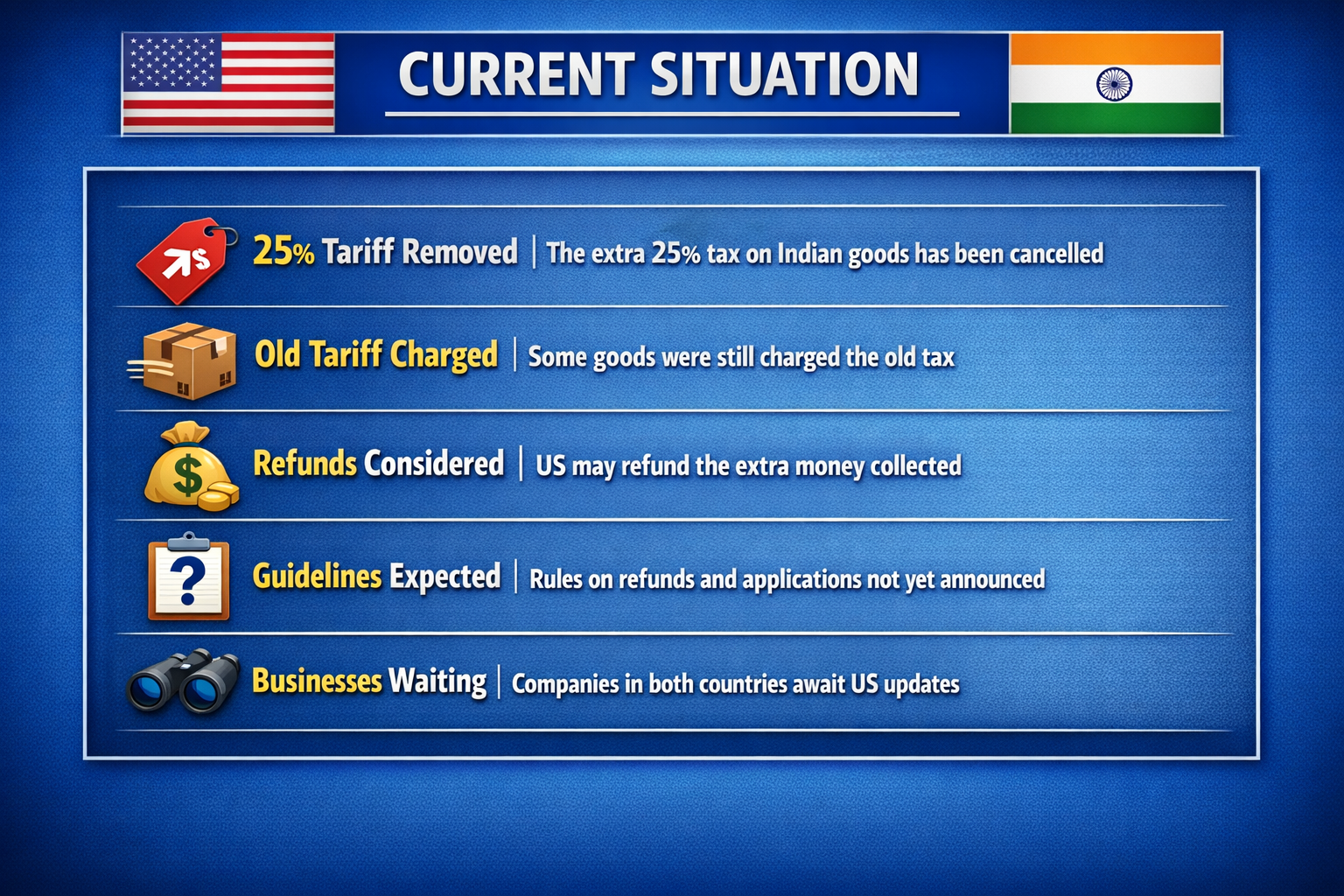
The United States government, under President Donald Trump, announced to return extra taxes that are collected on goods which are imported from India. This is only applicable when the US removes a special penalty tax of 25%, which is placed on Indian products. This step is to reduce trade problems between the two countries and improve the economic relationship.
The possible refund relates to duties collected during a transition period when the policy change had already come into effect, but customs systems and procedures had not been fully updated. As a result, some Indian shipments entering the US were charged higher tariffs even though the penalty levy was no longer applicable.
Background: Why the Tariff Was Imposed
The tariff issue dates back to 2025, when the Trump administration imposed an additional 25% penalty tariff on selected Indian imports. This penalty was introduced on top of existing duties and was directly linked to India’s continued purchase of crude oil from Russia. At the time, the US and several Western nations were enforcing economic sanctions against Russia due to ongoing geopolitical conflicts. The US administration argued that countries importing Russian oil were indirectly supporting the Russian economy and undermining global efforts to pressure Moscow. India, however, defended its position by stating that energy security was a national priority and that it had to secure oil supplies at affordable prices to support its growing economy. Despite India’s explanation, the US went ahead with the penalty tariff, leading to a sharp increase in the cost of Indian goods in the American market.
Impact of the Penalty Tariff on Indian Exports
The 25% penalty tariff had a noticeable impact on Indian exporters. Several sectors that depend heavily on the US market faced increased costs and reduced competitiveness. These included textiles, garments, jewellery, engineering goods, auto components, chemicals, and certain consumer products. With higher duties, Indian products became more expensive for American buyers. In some cases, importers either reduced their orders or shifted to suppliers from other countries to avoid the higher costs. Exporters in India reported margin pressures, order delays, and uncertainty in long-term contracts. Trade experts also warned that prolonged tariff tensions could hurt investor confidence and disrupt supply chains that had been built over years of cooperation between Indian and US businesses.
Trade Talks and Policy Reversal
After months of diplomatic engagement and trade negotiations, both sides worked towards easing the dispute. Senior officials from India and the US held multiple rounds of discussions to find a temporary solution while exploring the possibility of a broader trade agreement. As a result of these talks, the Trump administration announced the removal of the 25% penalty tariff on Indian imports. The policy change officially came into effect on February 7, 2026. With this decision, Indian goods were no longer subject to the punishment-related levy, although some standard tariffs continued to apply. The overall tariff burden on Indian exports was reduced, which was welcomed by exporters and trade bodies in India. The decision was also interpreted as a signal that the US was willing to take a more balanced approach towards India on trade issues.
Problem During the Transition Period
Despite the official removal of the penalty tariff, complications arose during the transition phase. Some shipments that arrived in the US after February 7 were still charged the old 25% penalty. This happened due to delays in updating customs software, documentation mismatches, and shipment timelines that overlapped with the policy change. Importers who had already paid the higher duty raised concerns with US customs authorities. Industry representatives pointed out that businesses should not be penalized for administrative delays once the government had formally changed the rule. It is these excess collections that are now being considered for refunds by the US administration.
Possible Refund Mechanism
According to sources familiar with the matter, the refunds would be processed through the US customs system. The money would not be paid directly to the Indian government. Instead, it would go to the US-based importers or companies that paid the extra duties at the time of clearance. Eligible importers may be required to submit documentation proving that their shipments arrived after the penalty tariff was withdrawn but were still charged under the old rule. Once verified, the excess amount could be refunded. Officials have not yet announced the exact timeline, procedure, or total value of the refunds. However, the indication itself has been seen as a positive step in addressing trade grievances.
Reaction From Indian Exporters
Indian exporters have welcomed the possibility of refunds, calling it a fair and reasonable move. Industry bodies have stated that while the removal of the penalty tariff itself was important, correcting excess collections is equally necessary to restore confidence. Exporters believe that refunds would help ease cash flow pressures, especially for small and medium enterprises that were hit hardest by the sudden increase in tariffs. Many companies had to absorb the extra cost or renegotiate contracts during the penalty period. Trade associations have also urged both governments to ensure smoother implementation of policy changes in the future to avoid similar issues.
Broader Implications for India–US Trade
The rollback of the penalty tariff and the potential refunds are part of a wider effort to stabilise India–US trade relations. The US is one of India’s largest export destinations, and India is an important trading partner for the US in Asia. Improved trade ties could benefit both sides by supporting supply chains, encouraging investment, and boosting economic growth. Lower tariffs make Indian goods more competitive in the US market, while American companies benefit from reliable sourcing and access to India’s large consumer base. Analysts say that this episode highlights the complexity of global trade in a politically sensitive environment and the need for continuous dialogue between major economies.
Link to a Future Trade Agreement
Officials from both countries have indicated that the current arrangement is temporary and that discussions are ongoing for a more comprehensive trade agreement. Such an agreement could cover areas like tariff structures, digital trade, intellectual property, agriculture, manufacturing, and dispute resolution. A long-term agreement would provide greater certainty to businesses on both sides and reduce the risk of sudden policy shocks. While progress may take time, recent developments suggest a willingness to move in that direction.
Strategic and Diplomatic Significance
Beyond economics, the tariff issue also has diplomatic and strategic implications. India and the US cooperate closely in areas such as defence, technology, energy, and regional security. Trade disputes, if left unresolved, can spill over into other areas of cooperation. By removing the penalty tariff and considering refunds, the Trump administration appears to be taking steps to prevent further strain in bilateral relations. Observers say this could help maintain momentum in broader strategic engagement between the two countries.
Current Status and Next Steps
Companies in both countries are waiting for the Refund process from the US government.
- 25% extra taxes on Indian goods are to be removed
- Some shipments that were still charged the old tax are to be updated
- Rules and regulations for applying on refund are to be announced, who can get refunds.